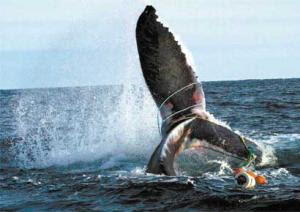
Hello everyone, it's Danielle with Quoddy Link Marine. I just want to report that there is another North Atlantic right whale entangled. Right whale #3333, last reported gear-free in the Bay of Fundy on August 6, 2007 was sighted by the New England Aquarium aerial survey team on January 29th, 2008 10 miles off the coast of Florida. The five-year old male looks to be in good condition, free swimming and diving well. Below are some photos taken today.
I have also included the diagram (done by Scott Landry) of the entanglement.
The whale was lost by the aerial survey team but if any news comes up I will keep you posted.
Hello There, it's Danielle with Quoddy Link Marine. I just wanted to update everyone on our Bay of Fundy Whales. I'm sure most of you heard about the humpback whale that was entangled and rescued off the coast of Grand Manan before Christmas. Below is a report from Deb Gleason, the Emergency Relief Responder from the IFAW Canada office from December 23rd, 2007;
"It has been a very exciting couple of days for IFAW’s Campobello Whale Rescue Team (CWRT) operating in the Bay of Fundy.
On Tuesday I had a call from Mackie Greene, the CWRT team leader to let me know that an entangled humpback whale had been reported by a conscientious fisherman south of Grand Manan Island in the Bay of Fundy.
The whale was anchored by the neck with ropes, lobster traps and anchors and although he was able to breath he could not move much.
Unfortunately, the sea was far too rough to attempt an immediate rescue and Mackie had to wait for the morning when they were expecting a brief period of calmer winds. None of us got too much sleep thinking about the whale stuck in the stormy ocean unable to move and fighting for every breath.
Today at lunchtime I spoke to an exhausted Mackie Greene who had stepped back on shore, returning from the water south of Grand Manan.
It took over an hour to reach the 40 foot Humpback whale named “Pez” (this has since found to be an incorrect ID, the whale has now been named Campobello). When they found him they realized it would be a very difficult rescue as the whale had about 75 lobster traps and the connecting ropes and anchors wrapped tightly around him, anchoring him to the bottom of the ocean.
Mackie knew that if they did not rescue the whale today he would most certainly die.
The whale’s left flipper had 5 or 6 wraps of rope around it and they started there. Once they freed the flipper they went to work on cutting the ropes that somehow managed to braid together forming a tight noose around the whale’s neck. The whale had been at this location for 3-4 days and had been battling for his life through heavy storms while caught in this heavy gear causing severe bruising and cuts over most of his body.
Mackie said it took about an hour to complete the rescue. He has been rescuing entangled whales in the Bay of Fundy for many years and has seen some pretty horrible entanglements but this was by far the worst he’d seen.
It took over 30 rope cuts to free Pez and Mackie broke 3 knives and lost several poles in the process. Mackie said they did not quit until every last piece of rope and equipment was off the whale including a six foot piece of rope coming from his mouth.
Mackie said that as he watched the whale swim away he felt he would make a full recovery. Pez the humpback whale will have a happy holiday this year thanks to the efforts of Mackie and the team. I am just so proud that IFAW is able to support the work of these brave men as they risk their own lives to save these magnificent whales."
This whale was not previously sighted during the 2007 season in the Bay of Fundy by either Quoddy Link Marine or our friends across the Bay. Everyone at Quoddy Link would like to say thank you to our friend Mackie Greene and his Campobello Whale Rescue Team.
There is another whale that is familiar with the Bay of Fundy that is currently still in trouble. Right Whale #2645, an adult female that is currently entangled in Cape Cod Bay. She has a white line hanging from her mouth and extending another 45 feet behind her before disappearing under the water. The last time she was seen gear-free was on September 17th in the Bay of Fundy and she was reported entangled on January 12th, 2008 by the Provincetown Center for Coastal Studies (PCCS) Skymaster (aerial surveyor). Below are some photos from the entanglement.
I will keep you posted on any important and interesting whale news concerning the Bay of Fundy. Cheers from our Nations Capital and Love to my New Brunswick family, I miss you all so very much.
Hello everybody! It's Danielle with Quoddy Link Marine to bring you a summary of our incredible 2007 season. I'm sorry to have taken so long to bring you this report but I have been settling in to my winter home in Ottawa, ON. Our 2007 season was really an amazing one, with the greatest number of humpbacks I have recorded in 6 years (21 total), amazing bird life and consistent finbacks all season long. I hope you enjoy this summary and some of my favorite pictures from the season.
Our Scout Boat played a very large roll this season, searching the offshore areas and locating whales so our catamaran, full of eager whale watchers could spend more time watching whales and less time searching our 25 mile radius from St. Andrews.
Our season started great, right away in June with finback whales not too far from our home port of St. Andrews, NB and our humpbacks were not too far behind. On July 2nd we had our first humpback whale sighting, a familiar whale identified immediately as Cork, a female humpback born in 2002 to Mica .
Only July 7th we saw Hobo, another familiar humpback from previous seasons. Hobo is of unknown age and sex.
On July 8th we were surprised to see a large humpback...very large for us...who turned out to be Rhino, a mature female of unknown age.
On July 9th we were very surprised to find new humpbacks back in behind the Wolves, an archipelago of islands in the open Bay of Fundy. And can I clarify, when I say new humpbacks I mean lots of new humpbacks. I IDed 14 humpbacks, 13 new, that day! Identifying humpback whales, done by the black and white pigmentation on the underside of their fluke, is the most favorite part of my job. With the help of Jooke Robbins, the director of the humpback whale program at Provincetown Center for Coastal Studies in Provincetown, MA all but one of our 21 humpbacks from the 2007 season were positively IDed. The photo on the left is a close encounter with Scream, one of our new humpbacks on July 9th.
On July 22nd we were inshore watching some seals when John, our captain and owner spotted a male, freeze-branded grey seal on a reef off Casco Bay Island. I contacted DFO and the grey seal branded as "OX2" was identified! He was born on Sable Island (160 km southeast of Canso, Nova Scotia) on December 30, 1997 and weaned on January 19, 1998 at 63.5 kg and 120cm. Also, he has been sighted in the breeding colony on Sable Island on January 26, 2005. Thanks to Mike Hammill (IML) and Don Bowen and Jim McMillan (BIO) for their help in identifying this grey seal.
The bald eagle sightings were incredible this year. With this amazing raptor officially taken off the endangered species list in the States, the bald eagle is always a highlight on our departures.....no matter how fantastic the whale sightings are!
On August 6th I had the privilege of seeing an animal I have waited 6 years to see, an ocean sunfish (Mola mola) and let me tell you, I was ecstatic! These bizarre looking fish, from the same family as pufferfish, average about 6 feet long and weigh 2200 lbs! The most obviously strange part is their shape, they look like a fish head without a tail. Through the course of evolution their caudal fin (tail) has disappeared and been replaced by a pseudo-fin called a clavus. Their diet consists mainly of jellyfish and to maintain their bulk they have to consume a very large amount. Ocean sunfish are covered in a slime instead of scales and they swim by a characteristic sculling motion of their dorsal and anal fins. They are the heaviest "bony" fish in the world, but its body is actually comprised of mostly cartilaginous tissues which is lighter than bone and can allow it to grow to such a large size which is uneconomical for other bony fishes. For more information on Mola mola visit "Ocean sunfish- Wikipedia, the free encyclopedia" http://en.wikipedia.org/wiki/Ocean_sunfish
On September 2nd our second vessel, the M/V Island Link spotted a very young humpback whale in an area affectionately known as the Happy Hunting Ground. This inshore area is not common for humpback whales but in some seasons can be a very common area for much larger finback whales. This small humpback never raised its tail so I wasn't able to get a positive ID, maybe "he" will show his "face" in the years to come.
In August and September one of the awesome sights we saw on many occasions were northern gannets. This impressive seabird can have a wingspan of over 2 metres. We saw both immature and mature birds, with the young ones reaching their adult colours at 4-5 years of age. One of the most amazing things about watching gannets is the main way they feed. They are plunge divers, sometimes diving from over 100 feet in the air down into the water to catch fish. Their streamlined body has air cells between the skin of its neck and shoulders and the muscle beneath. When a gannet prepares to dive these air cells will inflate and cushion the body as it strikes the water. Gannets are also one of only a few birds to have binocular vision, therefor both eyes can see forward at once.
Here you can see a northern gannet plunge diving and on the left is a small harbour porpoise feeding as well. All of the animals here are feeding on the same food source, herring!
A mature northern gannet with its pale yellow head and piercing blue eyes.
On September 7th we recorded a small pod of Atlantic white-sided dolphins in Head Harbour Passage, a deep, relatively narrow passage which runs on the north-west side of Campobello Island, NB. We were not able to get any photos, they were travelling very fast but it was a very exciting sighting.
On September 13th we had 2 new humpback whales sighted, 2 "new" humpbacks. We saw both EKG and Mustache offshore towards the Owen Basin. These humpbacks were both sighted in 2006 by Quoddy Link Marine and recorded as "unknowns". Unknowns are humpbacks who have not been previously recorded and who are not calves with their moms. EKG and Mustache were officially named at the 2007 Gulf of Maine Humpback Whale Naming Event.
This is a shot of Mustache on one of my most memorable days on the Bay in 2007. This young male was bubble cloud feeding, blowing clouds of bubbles under the surface and swimming sideways through the cloud, engulfing large amounts of prey (most likely krill).
On October 2nd, on our longest departure of the season (Thank You Matt, it was worth it), we sighted another new humpback whale....and immediately we knew it was a new humpback, solely by the size. This humpback was later IDed as Arrowhead, a large male humpback first recorded in 1976, and the first record shows him as an adult! How's your addition? That means that Arrowhead is more than 31 years old and is the oldest humpback officially recorded in our part of the Bay of Fundy in the last six years.
This is Arrowhead.
On October 17th we recorded another new humpback! This whale was easily IDed as Spinnaker, a female humpback born in 2004. Spinnaker was sighted earlier this season off the coast of Maine.
Quoddy Link Marine did 2 very special trips this season 35 miles from St. Andrews to search for the critically endangered North Atlantic right whale. On September 16th and September 30th we made our way into the open Bay of Fundy and we were very successful finding many right whales on each departure. The most exciting part of both departures was the cow and calf pair sightings. I really can't even put into words the privilege of seeing multiple mother and calf pairs of a critically endangered species (world wide numbers of 300-350 individuals). It was absolutely amazing. I want to take a moment to say a very special thank you to everyone who joined us on these 2 trips, the conditions were not the greatest and you were all troopers, THANK YOU!
A cow and calf North Atlantic right whale pair.
The broad, smooth, triangular flukes of an adult North Atlantic right whale.
Below are some photos of Cork, our little 5-year old female humpback that has become very dear to everyone at Quoddy Link Marine. We had one very special day with her when she seemed very interested in our boat. To the right you can see her rostrum (the front of her head) and some very lucky passengers on our upper deck. Her curiosity continued for both our morning and afternoon departures.
Our lucky afternoon passengers with a close encounter with Cork.
This is Corks' fluke. You can see the unique, black, cork-like marking on the right hand side of her tail which gave her her name.
This was AMAZING. That's me in the bow of our Scout Boat and Matt (one of our captains) leaning over the side and that is Cork RIGHT beside us. I didn't take any pictures of her here, I just watched, with my eyes....in complete awe!
What an amazing season we had. The finbacks were so consistent, especially compared to last year. We had finback whale sightings around our inshore areas including Blacks Harbour, Bliss Island, Whitehorse and even directly off Head Harbour Light on the northern tip of Campobello Island. Our 2007 season was also amazing for humpbacks, my best in 6 years. In our little part of the Bay of Fundy we documented 21 humpback whales:
- Arrowhead - Blanco - Cork - EKG - Galapagos - Grand Manan - Hawksbill - Hobo - Ibex (Mr. Burns) - Littlespot - Mallard - Mustache - Pierce - Puppet - Rhino - Scream - Shockwave - Spinnaker - Thistle - Waterspout and our little unknown from September 2nd and 3rd.
I also wanted to included this video that Melanie, one of our naturalists and our lobster expert, took of Hobo breaching. This was a very special trip and we certainly do not see whales jumping out of the water on each and every trip but it does happen, and when it does it's unforgetable.
It was a great year fpr humpbacks in the entire Bay of Fundy, with 178 identifed humpbacks, atleast 18 new indivduals and 19 calves (70 calves including the rest of the Gulf of Maine)! It is on the best years in humpback whale research in the Bay of Fundy.
As I sign off for the 2007 season I just want to thank all who joined us to experience the Bay of Fundy.....Catamaran Style. I also want to thank Jill, Melanie, Louise, Courtney and Dee....this summer was amazing, thank you girls!! And to John, Lisa and Matt, thanks for the willingness to go the distance, those extra 5 miles really do make all the difference and that's why we recorded over 20 humpbacks this season.
Check back next May as we prepare for the 2008 whale watching season and make your way to St. Andrews and come and experience the Bay of Fundy....Catamaran Style!
Hello everyone, well, even though our 2007 whale watch season has officially come to a close we are still reporting whales in our area, and not just reporting whales but still documenting new whales in the Bay of Fundy! Today, on a special charter with absolutely beautiful weather for this time of year, we had a new humpback whale, this is Spinnaker you see below. Spinnaker is a female humpback born in 2004 and she was reported earlier this season off the coast of Maine.
Our Scout Boat was out today to help us look for whales and also take some photographs but I snapped this one of John! This is Mustache, a juvenile male humpback whale who we also saw today. While John was out on the Scout Boat searching a bit more he also reported EKG and Cork, 2 humpbacks we are familiar with at Quoddy Link Marine. Thanks so much for checking in today. I'll keep posting as long as I have new info to post so check back often. I'll make sure to have an "End of Season" recap in the near future as well!
Hello all, it's Danielle with Quoddy Link Marine. We had another great trip today, and one that we were not sure if we were going to be able to get in due to the forecasted weather. We did make our way off Southern Wolf and found Arrowhead, a male humpback whale first sighted in 1976. He's a very large humpback and great to see. We always seem to get some great looks at him and today was no different. Especially with the sun today we were able to clearly see his long, white pectoral flippers at his side which are visible in the photo below.
On the photos above and below you can slightly see a rainbow in the blow (or exhale). The photo on the very bottom, the rainbow that is there is from the moisture from his blow. Thanks for checking in today. I don't know how tomorrow will turn out, with thunderstorm and gale-force wind warnings......I'll make sure to keep you posted.
Hello everyone, it's Danielle with another update from Quoddy Link Marine. We had a great trip today, and nice to get it in before we get some serious fall winds over the next few days. With the help of Matt on our Scout Boat (left) we made our way out to South Wolf where we found Mustache (below). Mustache is a juvenile male humpback we have been watching for 2 years now. After spending some time with him we made our way about 3 miles, towards Grand Manan, where Matt had found us another humpback whale. This time it was Arrowhead, an adult male first sighted in 1976! After spending some time with him we started to make our way back to St. Andrews but we did make time to stop with a minke whale, a bald eagle and some harbour seals on our way!!
Below is a video of Arrowhead Melanie, one of our naturalists, took yesterday.
Thanks for checking in today! The season isn't over yet so keep checking for more updates.
Hello everyone, it's Danielle with Quoddy Link Marine back from a great fall day on the Bay of Fundy. We left for our 1:30 departure and headed out into the Grand Manan Channel where we found 3 fin whales. It was great to spend some time with these enormous whales but at the same time we were wondering where our humpbacks were. So John, our owner and captain, decided to run us off towards the Wolves, an archipelago of islands in the open Bay of Fundy. As we were approaching we saw a blow and quickly saw it was a humpback but when we arrived I was so happy with who I saw....it was Arrowhead, a humpback we saw for the first time last week! Arrowhead was first sighted in 1976 which puts him at at least 31 years old! And he is BIG! Below is a photograph I took today of his fluke.
I've left you with a photo below of Arrowhead, that is Campobello Island way in the background. Our season is quickly coming to a close with our last scheduled whale watch on October 14th at 1:30 pm so come and join us and experience the Bay of Fundy....Catamaran style!
Monday, October 08, 2007
Hello everyone, it's Danielle with Quoddy Link Marine. Sorry for the lack of posts over the past few days I'm just a bit under the weather and I will be keeping this one short but I wanted to make sure that I kept you all posted on our sightings. The season continues to be great even as the end draws more near. We have been seeing both humpback and fin whales on the almost every departure. The weather has been true to autumn on the Bay of Fundy with quite a bit of wind but nothing too strong to keep us in the harbour. Below is a photograph I took today of Cork, a 5 year-old female humpback whale.
This is Mustache, a juvenile male humpback. He even treated our passengers a few days ago with a tail thrash (whipping his tail and 1/2 his body right out of the water).
Well....thanks for checking in and I will keep you posted on our sightings for the rest of the week. I've left you with a photo of a grey seal we saw yesterday off Black Rock.
Hello everyone, it's Danielle with Quoddy Link Marine with an update from today's whale watch. It was a breezy fall day but with a well educated guess on where to start our search and some luck we found Cork (below), a 5 year old female humpback whale around the Owen Basin this afternoon. We also found a large fin whale but it was difficult to get a good look with the 4-5 foot breaking sea. On our way back to St. Andrews we stopped at a familiar herring weir (a fish trap for wild herring) off the northern tip of Campobello Island, NB and found a very small minke whale trapped inside. We had heard reports of the little one and were not surprised to see him still there. Large whale rescue has been informed and they are monitoring the situation but it is not a life threatening place for a minke whale to be (there is lots of herring to eat inside!). A close eye will be kept on the minke whale and if he doesn't swim out very soon the net surrounding the weir will be lowered at high tide and whale rescue will be called to the scene. Thanks so much for checking in today and keep checking for the last of our updates as our 2007 season is nearing the end!

 I have also included the diagram (done by Scott Landry) of the entanglement.